A multi-trillion-dollar AI debt buildout is underway, and I wanted to understand how the market is actually funding and pricing it. What I found is that a GPU loan is only as good as the next operator’s ability to run the software stack.
One of the largest debt buildouts of the decade is in AI hardware, and I wanted to dig into the financing of it to understand how the market is pricing it. One of the most basic initial questions I had was: if a lender of GPU debt has to repossess the GPUs - what exactly do they end up holding? I discovered that the answer has far less to do with the silicon than with the software, because software determines whether the next owner can fundamentally put those machines back to work. I was interested in the debt markets view, because the flow of funds is always an interesting story as that’s where the underlying risk is forced into a price.
This is not meant to be an essay about whether AI debt is a bubble, rather, it’s an essay about what makes compute financeable at all, and my take from all the research below is that it’s mostly software, not silicon.
Across this essay, I use “portability” to mean three related things:
Workload portability means a model can move across different silicon with bounded cost in performance, correctness, and engineering effort.
Operational transferability means a qualified third party can take over a running cluster and keep it earning.
Asset liquidity means the hardware itself can find a new operator or buyer at an observable price.
The argument of this essay is that a causal chain exists that the market isn’t appreciating or understanding, and here’s a simple summary of how the above three points relate - the first makes the second cheap, the second is what makes the third real, and the third is what the debt markets actually price.
I'll also refer to “fungibility” a lot, and here I do not mean every accelerator is identical or that every workload belongs on every chip. I simply mean the interchangeability inside a machine’s “capability window” - that is, whether that workload can move among the machines capable of serving it with predictable performance, cost and correctness within their usable life. My view is that compute will become fungible first where the switching cost is lowest - inference, batch processing, much of fine-tuning - long before it reaches frontier training, where a failure can cost weeks and where the collective communication patterns bind you even more to a single hardware vendor.
The numbers underneath the buildout
The magnitude of what is being borrowed against AI hardware to finance the future of compute has reached unprecedented levels, and I don’t think most people appreciate the sheer scale of it. AI-related companies and projects raised at least $200 billion of new debt in 2025 alone - a figure that undercounts the private deals - and that lands on top of a much larger instrument - by October 2025, the outstanding bonds of AI-tied issuers totaled $1.2 trillion, the single largest sector of the US investment-grade market at roughly 14%, larger than American banks - though not all of it was raised specifically to finance AI infrastructure.[1] The five largest hyperscalers issued $121 billion in new bonds in 2025 alone, more than four times their average annual issuance over the prior five years, and the four largest have guided to roughly $725 billion of combined capital expenditure in 2026 - up nearly 80% on what they spent the year before, with Alphabet alone raising its range to $195 to $205 billion on July 22, 2026.[2]
In my research, I learnt that underneath all this financing sits a newer structure - securitized data center debt, which JPMorgan’s CMBS research team projects will reach $30 to $40 billion a year in 2026 and 2027, up from roughly $27 billion in 2025.[3] And the pace is accelerating - AI-related bond issuance topped $250 billion by the middle of 2026, even as the first signs of strain appeared - Amazon’s latest $25 billion sale seemingly met a cool reception, S&P cut Oracle to the last rung of investment grade over its AI spending, and Alphabet and Meta both paid real premiums over their prior deals just to access the market.[4] The Bank for International Settlements put a frame around all of this in January - the boom has structurally shifted from cash-flow financing to debt - free cash flow at the major AI firms now lags their capital expenditure outright - with private credit to AI companies growing from near zero to over $200 billion, roughly 8% of all outstanding private credit, and projected by the BIS to reach $300 to $600 billion by 2030.[5]
So where the hell is all this money going? At one end of this sit the neoclouds, whose entire business model is fundamentally borrowing against GPUs. Critically, these businesses don’t have a separate foundational core business like the major hyperscalers - for example, Google with Ads, Android or GCP, or Amazon with Shopping or AWS, or Microsoft with Office - that provides a strong and healthy balance sheet to feed the capital expenditure. CoreWeave, really the “template” for the category, has grown its total debt to roughly $25 billion - up from under $8 billion at the end of 2024 - across a series of delayed draw term loans collateralized by NVIDIA hardware and the customer contracts attached to it. I dug into their financials and found that when CoreWeave raised its first facility in August 2023, it was the first time H100s had ever been used as loan security.[6] Interestingly, every one of these structures awkwardly embeds an assumption about hardware residual values - that is, they need to determine what the hardware is worth in year three, year five, year seven, to a lender who may one day have to repossess it and find someone else to own it, and run it. That residual-value assumption is where a really interesting narrative lives, and I wanted to double down on that as I believe it deserves much closer scrutiny.
Someone else is setting the clock
A few close friends and I discuss (and argue! haha) regularly about compute and the future of AI. One of the bear case discussions we have around compute is as follows - software portability threatens compute’s underlying value - that is, if workloads can move freely across silicon, the premium NVIDIA hardware commands will erode and the loans written against it will ultimately sour, or at least be devalued. It’s a great hypothetical and I wanted to illustrate my position around why I think it gets the causality backwards.
I took a look at what actually happened to Hopper over the last few years. H100 rental pricing peaked around $8 per GPU-hour during the scarcity of 2023, with some on-demand rates exceeding $12. By mid-2024 the same capacity rented for $2 to $3. One-year reserved pricing bottomed at roughly $1.70 in October 2025 before recovering to about $2.35 by March 2026 as inference demand surged, settling around $2.25 by mid-2026.[7] Interestingly, the price of a three-year-old H100 system today spans from roughly 45% of new price (hashrateindex’s used-market tracking) to roughly 69% (Silicon Data’s index).[8] I wanted to compare that to a well-known, well-understood industry like aircraft, a staple of debt financing (I went into this knowing absolutely nothing about aircraft financing mind you!) Aircraft appraisal is imperfect, but it rests on a strong set of standardized principles - maintenance records, known configurations, decades of transaction history, and a far deeper remarketing market than compute has today. Against that baseline, GPUs have an incredibly wide pricing window - spanning 45 to 69% at the same age - which is fundamentally what an asset without a true liquidity layer looks like when you try to value it. I attempted to graph this below:
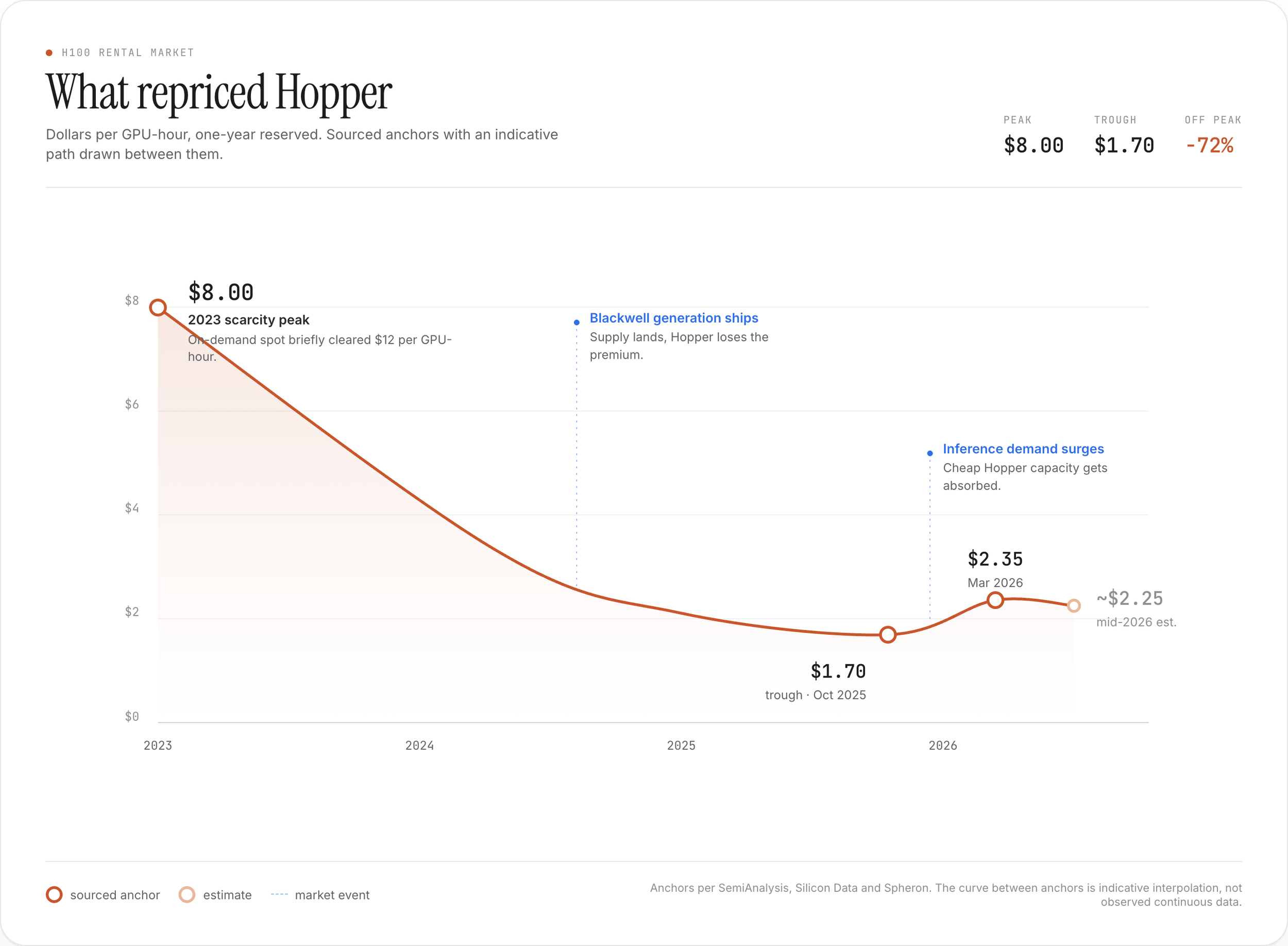
FIG. 01 H100 GPU-hour pricing, 2023-2026. Sources: SemiAnalysis, Silicon Data, Spheron.
The obvious question to ask after looking at the above graph is: what caused Hopper values to fall and slowly rise? Hopper repriced sharply as Blackwell began shipping - so the simplest conclusion is NVIDIA’s own release cadence, which they have publicly committed to now as a one-year rhythm. Put simply, when your hardware is locked to a single vendor, you don't get to decide how fast it loses value - they do. More directly, the GPU’s collateral value is a function of NVIDIA’s roadmap and is enormously concentrated by it.
In my research, it seems the industry can't even agree on the single most important input to the model. In the same quarter, Amazon shortened the assumed useful life of a subset of its servers and network equipment from six years to five, explicitly citing the accelerating pace of AI hardware - and took $920 million of accelerated depreciation retiring equipment early - while Meta extended the lives of certain servers and network assets to 5.5 years, cutting its 2025 depreciation expense by roughly $2.9 billion.[9] Neither company breaks these estimates out by chip type - they are fleet-level judgments, not GPU specifics (which sucks) - but the direction is the point - same reporting period, the same asset category, and opposite conclusions that are worth billions. The point is not that one company is wrong; it's that no stable consensus exists on useful life even at the fleet level, and there is little transparency into it either. When the most sophisticated infrastructure operators on the planet cannot agree there, GPU-specific residual value is even less settled - which is precisely the condition under which lenders demand something else to underwrite against.
Unsurprisingly, the disagreement has already escalated into a public accounting fight of the AI compute boom. In November 2025, Michael Burry accused the five largest hyperscalers of understating depreciation by roughly $176 billion between 2026 and 2028 - depreciating hardware built on a two-to-three-year product cycle over five- and six-year schedules - with Oracle’s 2028 earnings overstated by nearly 27% and Meta’s by nearly 21% on his math. It was so significant that NVIDIA felt compelled to answer with a memo to Wall Street analysts.[10] I don’t presume to have a position on the accusation itself - rather, what interests me is the defense, because the strongest argument for long useful lives is how the lifecycle of a GPU cascades down - the claim that a GPU spends its first years on frontier training, then serves inference, then lesser workloads, earning its keep across six years. I find that what the defense quietly assumes is that workloads can actually move onto older silicon, smoothly and at high utilization. This is juxtaposed against the fact that older hardware is already booked revenue for hardware makers, and the software optimizations get forgotten by hardware vendors in favor of the latest and greatest silicon - this is an age-old pattern in the industry. So the bull case for hyperscaler earnings and the bear case for GPU collateral are, underneath the accounting, the same question - both resolve, at least in my thinking, towards whether software makes compute redeployable.
What the market is underwriting
I wanted to dive deeper and found something interesting in CoreWeave’s filings. Between 2023 and 2026, CoreWeave’s cost of debt collapsed - from roughly 15% on that first Magnetar and Blackstone facility, a rate normally reserved for poorly rated borrowers, down to a 5.9% fixed tranche on the $8.5 billion DDTL 4.0 facility, which closed in March 2026 with an A3 investment-grade rating - the first ever for GPU-backed financing. A DDTL (as I learnt) is a delayed draw term loan - it lets a borrower draw predefined portions of a pre-approved amount over time rather than taking the lump sum upfront. CoreWeave numbers these facilities sequentially - DDTL 1.0 through 5.0 so far - so the series doubles as a time-lapse of how lender comfort has evolved, and I’ll reference three of them below.
The simple reading of this that I first had, was that lenders got comfortable with GPUs as collateral, but as I read more I realized that the filings tell a different story. DDTL 4.0’s investment-grade rating rests explicitly on a six-year take-or-pay contract with Meta - a counterparty rated Aa3 while CoreWeave itself sits at Ba3 - and the rating agencies are seemingly pricing Meta’s balance sheet, not the underlying GPUs. I read Moody’s rating action closely and among the structural protections required for the A3 was a license of CoreWeave’s operational IP, ensuring the GPU clusters keep running - operated by Meta or a qualified third party - even if CoreWeave itself goes bankrupt (which I believe is not going to happen). Read plainly, the investment-grade structure required contractual protection for operational continuity before the hardware could carry the rating - and the license is not cross-silicon portability; it is operational transferability defined by the contract. The underwriter wants step-in rights and continuity because the technology stack does not yet provide it natively. Just two months later, the market then supplied the closest thing to a comparison - DDTL 5.0, backed by the same class of hardware but by two non-investment-grade customer contracts, priced roughly 290 basis points wider and came in at Ba2 / BB+.[11] I wanted to visualize this, and I mapped that below:
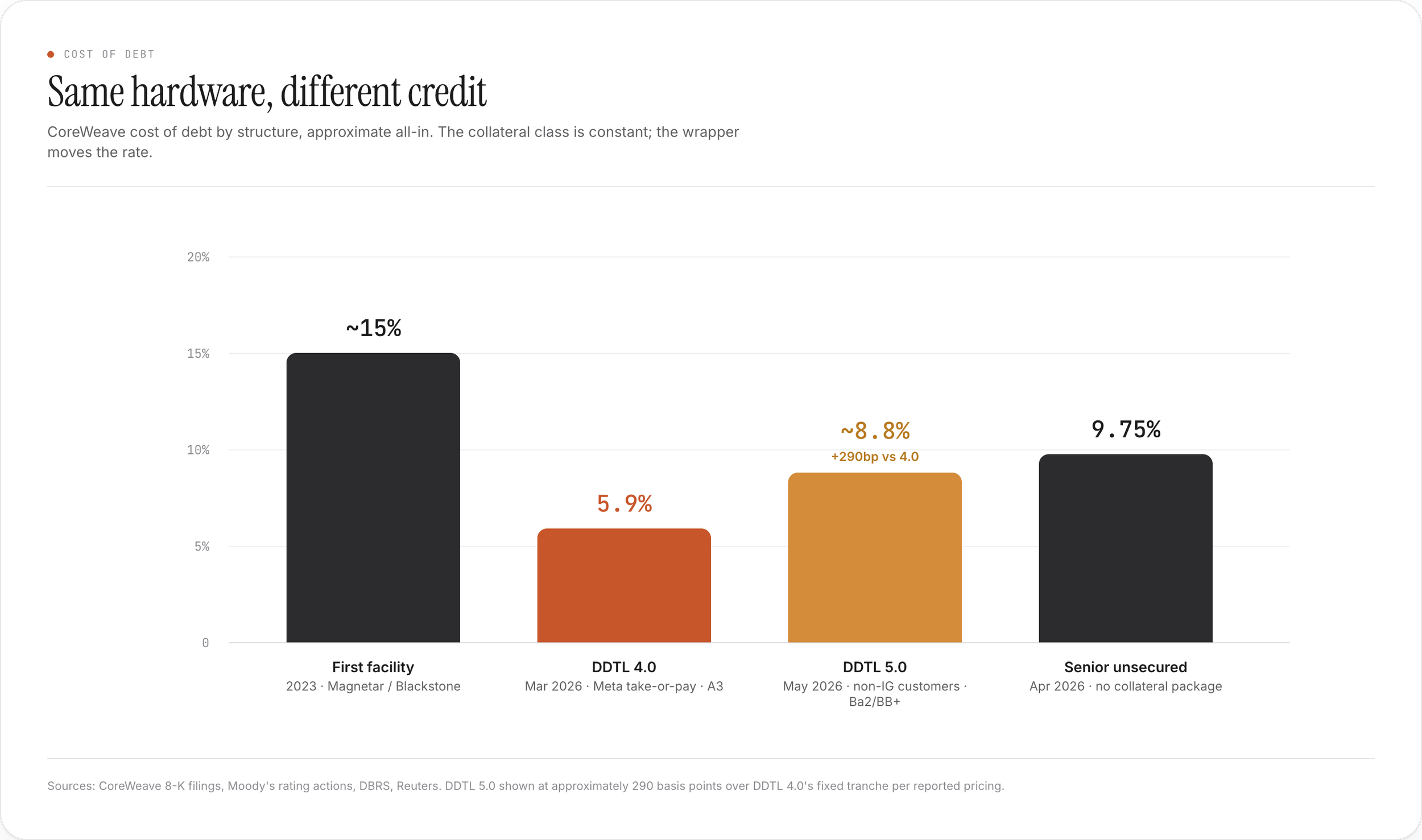
FIG. 02 CoreWeave debt pricing by structure, 2023-2026. Sources: CoreWeave 8-K filings, Moody’s rating actions, DBRS, Reuters.
What’s interesting is that the structures are not identical at all - you can easily get lost in the terms (as I did) - but they are the closest public comparison available - a similar collateral class, materially different counterparties and protections, and roughly 290 basis points of difference in price. For the same class of chips and a weaker counterparty, you get an entirely different credit outcome. So the conclusion I came to is that the hardware alone does not carry the rating - the customer and the contractual protections around it are doing most of the work. If more doubt remains in your mind, CoreWeave’s own capital stack removes it - two weeks after DDTL 4.0 closed at 5.9%, the parent company issued $2.75 billion of senior unsecured notes at 9.75%.[12] So if we summarize we have - same operating company and asset base, similar market timing, but radically different security and contractual protections. The comparison is not a clean collateral spread, but it shows how decisively “the wrappers” around the contract - aspects like contracted cash flows, security, amortization and step-in rights - changes the credit outcome. The hardware contributes to the structure, but it does not carry the credit on its own.
I discussed these findings with some friends, some who argued that none of this is new - that project finance has always worked this way, that power plants are financed against purchase agreements rather than the merchant value of their turbines, and that GPU debt is simply infrastructure finance starting to mature. I think that rebuttal is fair in regards to the mechanics, but my position is that it’s wrong about the thing that matters. I learnt that in a power project, the offtake contract - the long-term deal that pre-sells the plant’s output - is shorter than the asset’s life, so the plant may run for forty years, but the contract only exists for fifteen - and lenders can measure their exposure against the decades of value that remain. In DDTL 4.0, the numbers are inverted - Moody’s structure requires the loans to fully amortize and mature less than five years after the draw period ends, inside the term of the Meta contract itself. Whereas power-project debt can rely on the asset beyond its offtake contract, this GPU facility is structured so the contract retires the debt before lenders must rely materially on residual hardware value - and that inversion is pretty incredible. Requiring full amortization inside the contract term means the structure places minimal reliance on any hardware value remaining afterwards.
And despite all this, the market hums on - don’t think for a minute that the co-signing stops at customers. NVIDIA has invested $2 billion into each of CoreWeave and Nebius - capital that flows straight back into GPU purchases - and has gone further with CoreWeave, under an agreement initially valued at $6.3 billion that obligates NVIDIA itself to purchase any unsold data center capacity through April 2032.[13] This is an incredible financial construct - the vendor of the collateral is guaranteeing demand for the collateral. And the pattern now extends beyond NVIDIA’s ecosystem - in the roughly $36 billion Apollo and Blackstone facility that buys Google TPUs to lease to Anthropic - one of the largest private credit deals ever done - the senior tranche priced near 5.75%, with pricing supported by a guarantee from Broadcom, the chip’s co-designer, providing a maximum exposure of $29 billion per Broadcom’s own filing that reporting characterizes as residual-value support, with Google reported to backstop the lease payments on top.[14] Again in this case, the hardware maker is manufacturing the residual value that a liquid market would otherwise provide natively.
The systemic concern is what happens when all of these contractual supports overlap. Structures like this are exactly what the Bank for International Settlements questioned in January - financing that can “mask leverage by moving it off the balance sheet,” though leverage out of sight is still leverage. I was fascinated to read that by June 2026, the BIS’s Annual Economic Report went further, describing a complex web of poorly disclosed private arrangements across the sector - circular equity-for-purchase-commitment deals, sale-leaseback data centers with embedded exit clauses - carrying risks of “the same asset being pledged multiple times.” For a lender, and certainly any person damaged by the 2008 financial crisis, that phrase is somewhat terrifying if we cannot price what we cannot verify.[15]
That pattern has now moved from billions to hundreds of billions. On July 27, The Wall Street Journal reported that NVIDIA is in talks to provide roughly a $250 billion backstop for OpenAI’s lease of a 10-gigawatt Ohio campus, while separately discussing financing support for as much as $350 billion of NVIDIA chips. Neither arrangement is final, and the $250 billion guarantee would support the lease and build-out rather than the chips themselves. But the proposed architecture is hard to ignore - the vendor would be standing behind the financing of the infrastructure that creates demand for its product, and may finance the silicon inside it on top. It’s critical to know that vendor financing itself is old - what is new is the sheer scale of what is being done now - and the possibility that the financing is no longer merely serving demand, but pulling it forward.[16]
Meanwhile the cost of all this borrowed credibility keeps compounding - CoreWeave’s interest expense reached $536 million in the first quarter of 2026, roughly 26 cents of every revenue dollar, and they are guiding it even higher. In my view, the real trillion-dollar question underneath this buildout is not whether GPU collateral holds its value - it’s really why GPU collateral needs a hyperscaler co-signer and a vendor backstop in the first place, when one compares against a forty-year-old aircraft financing market that lends against aircraft with no such limitation.[17] One clarification on the aircraft comparison in the next section - a lender does not care about cross-silicon portability as an engineering virtue. A lender cares that portability expands the pool of workloads and qualified operators able to keep a seized asset earning. The credit property is not portability for its own sake - it is the transferable earning capacity that portability creates, and everything the aircraft market knows flows from exactly that property.
What can we learn from aircraft financing?
I wanted to understand from other debt markets how financing and risk assessment works, particularly in respect to liquidity of the assets. I decided to use an established industry and went deep into what happens when an aircraft lessor - a company that owns planes and leases them to airlines - repossesses a narrowbody, the industry term for a single-aisle commercial jet such as a Boeing 737 or Airbus A320. Within months, that aircraft is typically flying for another airline, on another continent, or repainted in a new operator’s colors. That is possible because the asset is standardized - each model has a common regulatory certification, the maintenance requirements and records transfer with the plane, a large number of airlines are already equipped and qualified to fly it, and appraisers have decades of transaction data to value it.
A three-year-old narrowbody commonly retains roughly 80 to 90% of its original value under normal market assumptions, depending on the model, its maintenance condition and the strength of the market.[18] Lessors and airlines can finance these aircraft at the lower borrowing costs associated with investment-grade credit, not against the metal alone, but against a repeatable collateral package - standardized designs, transferable maintenance records, predictable inspections, strong repossession rights and a very large global pool of qualified operators. Portability is not sufficient by itself, but it is the property that turns those protections into multiple bids and creates a liquid market. The analogy to compute is narrower than it first appears - I am not arguing that GPUs should hold value like jets. I am arguing that standardization expands the qualified operator pool, creates observable bids and shortens the path back to revenue. I wanted to try and visualize this - and this is what that looks like:
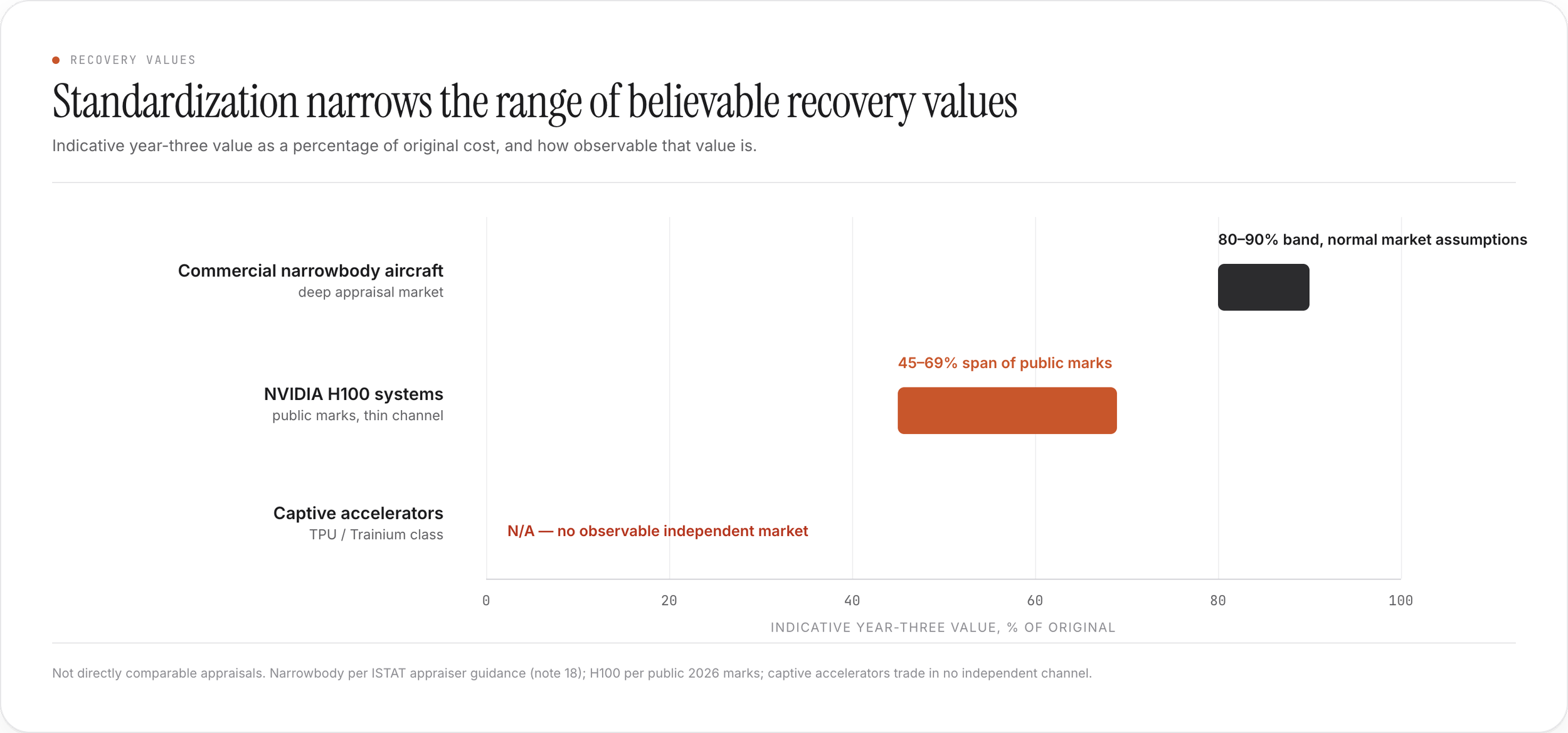
FIG. 03 Indicative year-three value marks and market observability - narrowbody 80-90% band per appraiser conventions (note 18), H100 span per public 2026 marks, captive accelerators with no observable independent market. Not directly comparable appraisals.
If we run this same repossession scenario on AI hardware today, currently it looks like this - a repossessed rack of NVIDIA GPUs has a real secondary market - dozens of potential buyers, an active resale channel, with a 45% year-three residual. It is the best case in the category, and it still needs a Meta contract to reach investment grade. But compare that to a seized pod of custom accelerators and you’ll have a different story entirely. During my years at Google working on TPUs, I saw from the inside how extraordinary vertically-integrated silicon can be - and how completely its value depends on the software stack, the compiler, the runtime, and the institutional knowledge of seasoned teams who have scaled it enormously to production. A repossessed TPU or Trainium pod currently has a very thin independent operator pool, dominated by the ecosystem owner and a small number of deeply integrated customers. Without a credible path to recovery, it becomes obvious that a lender cannot assign meaningful collateral value, no matter how phenomenal the hardware is at the workloads it was designed for.
In my view, this is the key insight the debt markets are circling around and the point I’m trying to make, fundamentally, every GPU loan is really a software loan. Repossessing hardware nobody else can program or run is like foreclosing on a factory where only the previous owner knows how to turn the machines on - the lender’s recovery scenario requires that someone else can run revenue-generating workloads on the seized asset. If operating the hardware depends on one company’s software and institutional knowledge, its recovery value collapses toward that of a highly specialized asset with a razor thin liquidity pool. I’ve certainly learnt that the aircraft market works because the interface between asset and operator is standardized. Compute has no such truly programmable interface today - CUDA is a moat for one vendor, not a standard for an asset class - and the entire financing stack is paying for that in spreads, in co-signer requirements, and in the simple fact that, outside the hyperscaler balance sheets, much of the asset-backed AI infrastructure market is still financed through heavily wrapped or speculative structures. The objection I hear most at this point is that “AI will simply write the missing software for every chip,” and I provide a perspective on this at the end of the essay - but note what a lender actually needs, which is not code that exists, but a stack that another operator can take over and run.
How does one determine what fungibility is worth?
I keep coming back to aircraft because it is where the debt market finally became legible to me. It is a mature asset-backed market, the structures have been tested through multiple cycles, and - most usefully - the prices are public. United Airlines is the cleanest “at scale” example I could find. In 2018, United issued bonds secured by a pool of aircraft - a structure the industry calls an enhanced equipment trust certificate, or EETC. United itself was rated below investment grade, what most people call junk, yet the safest parts of the aircraft financing were rated six to eight levels higher.[19] The difference was not that the planes had somehow become risk-free, rather, it was that lenders had a repeatable package around them - they financed only a small share of the aircraft’s value, had strong rights to recover the planes in bankruptcy, held cash reserves against missed payments, spread their claim across multiple aircraft, and most critically - they knew there was a global market of airlines capable of putting them back to work. In 2023, the senior portion of another United aircraft financing carried a 5.80% interest rate even while debt backed only by United’s general credit remained junk-rated. Comparisons with the same airlines’ unsecured borrowing suggest that this combination of standardization, creditor protection and resale liquidity can reduce financing costs by roughly one to two-and-a-half percentage points in some deals.[20]
I then wanted to compare GPUs to this United comparison so I could try to understand the ratings uplift the GPUs earn on their own using public data - there wasn’t one that I could find that was attributable to the hardware directly. CoreWeave’s A3 rating belongs to the Meta-backed deal, not from CoreWeave on its own. When the parent company borrowed without that contractual wrapper two weeks later, it paid 9.75% - and that gap tells us how little of the credit outcome the hardware earns by itself. The repayment schedules make the contrast even clearer - for example, in aircraft finance, the safest portion of debt backed by a pool of planes - known as the senior tranche of an EETC - is typically paid down over roughly 12.7 years. CoreWeave’s Meta-backed loan, by contrast, is structured to return all principal in roughly six, before the Meta contract expires. What I have come to learn is that the repayment schedule is often the clearest signal of how much faith lenders place in what the asset will still be worth at the end. It does not tell us when the GPUs stop being useful; it tells us lenders want their money back before they have to find out what those GPUs are worth without Meta. Again, I tried to map this visually and it looks like this:
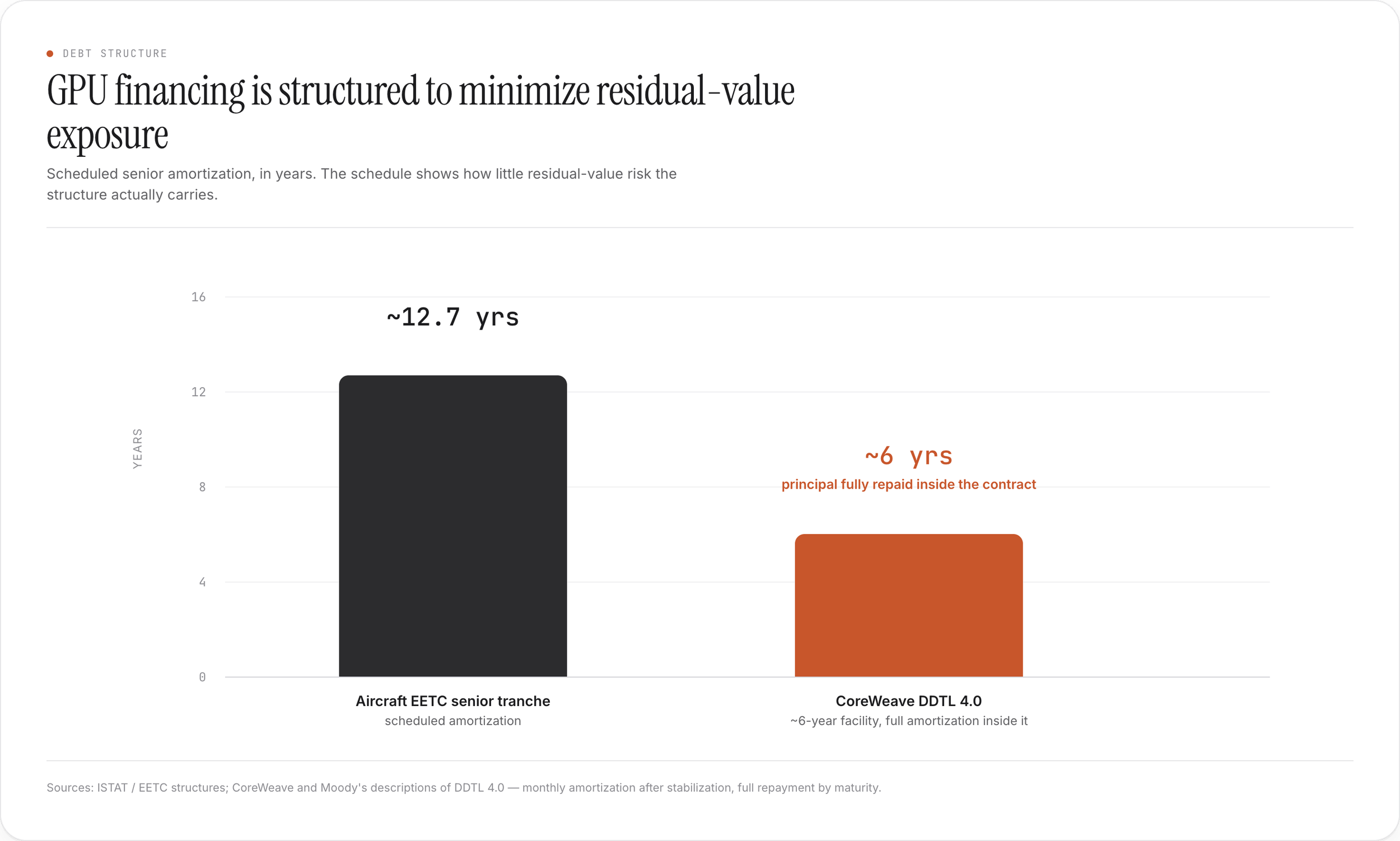
FIG. 04 Scheduled senior amortization: aircraft EETC vs CoreWeave DDTL 4.0, which fully repays principal inside the roughly six-year facility. Sources: ISTAT / EETC structures; CoreWeave and Moody’s descriptions of DDTL 4.0.
This chart illustrates that the financing structure appears willing to finance approximately the full cost of the deployed hardware, because of the Meta contract and not the GPUs carrying the repayment risk. Similarly, the Hut 8 data center serving FluidStack’s fifteen-year Anthropic lease is being financed at up to 85% loan-to-cost, with Google backstopping the lease payments.[21] Again this illustrates that lenders will advance substantially more, at materially lower cost, versus against pure GPUs. The public markets still show a sharp bifurcation rather than the mature continuum of an established collateral class - which is precisely the shape of a market missing its liquidity layer.
So now the obvious question becomes - what is that layer actually worth?
On CoreWeave’s roughly $25 billion of debt, every hundred basis points is about $250 million a year - and applied across even a fraction of the specialized AI-infrastructure debt market, the outcome is clearly in the billions. Even confined to the specialized, collateral-priced slice of the AI-infrastructure market, portability is economically material - and the addressable market grows with every single neocloud that borrows. It’s becoming really clear that the collateral pool is enormous and growing more so - NVIDIA’s data center revenue ran $47.5 billion, $115.2 billion, and $193.7 billion across its last three fiscal years - more than $350 billion of NVIDIA Data Center revenue across those three fiscal years, while the strongest publicly observable GPU-backed financing structures still rely on customer, vendor, or parent-company support. Morgan Stanley expects roughly $570 billion of AI-related issuance in 2026 alone.[22] Fungibility is not a rounding error on this market - it is a potentially material credit property that nobody is yet pricing.
Old chips still earn, if the software lets them
The strongest counterargument I’ve debated is that GPUs do not depreciate because of lock-in - they depreciate because next year’s chips are simply better. Aircraft hold their value because aircraft don’t rapidly improve as much each year, while GPUs do and this is undoubtedly true. However, there is no way that portability stops technological depreciation - nothing does - so the objection assumes that when a chip is no longer the best, its earning potential falls off a cliff - and again, that’s incorrect assuming software continues to work on the hardware. Azure ran its K80 and P100 fleets for seven to nine years before retiring them, and retired its V100 instances in late 2025, roughly seven and a half years after launch. Incredibly, even the T4, a 2018 chip, still generates rental revenue today. And more than six years after launch, the A100 remains the cost-optimal home for a huge class of inference and fine-tuning work at around $1.30 to $1.50 per hour. I also found that CoreWeave has said that H100s rolling off their original 2022-era contracts were rebooked at close to original pricing.[23] So I wanted to try and understand a July 2026 cross-section of rental prices against chip age and graph that - I found that every generation back to 2018’s T4, still clears at a positive price. The graph below compares different GPU generations rather than tracking one chip over time, but even so, the picture looks nothing like the “fastest-depreciating asset in history” framing common in the debt market.[24]
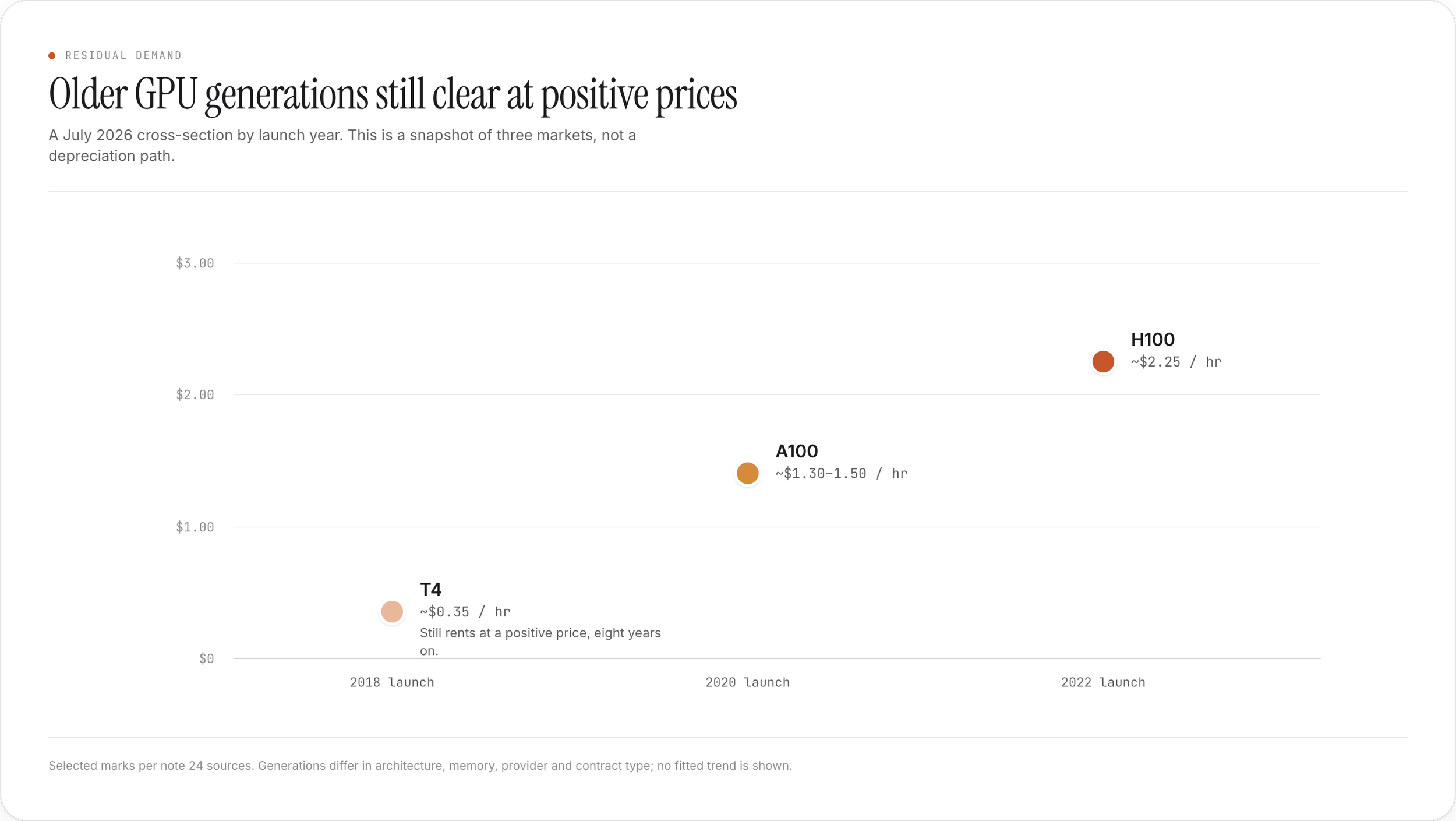
FIG. 05 Selected July 2026 rental marks by GPU launch year - a cross-section across generations, not the depreciation path of any single GPU. Sources in note 24.
If we want to dive into a hypothetical - we can take an H100 and assume it costs roughly $30,000 and rents at the above blended price, assume approx 70% utilization, and generates approximately $65,000 in gross revenue in its first three years. We can then approximate that it will generate $45,000 more across years four through seven as AI workloads can continue to execute on it (e.g. batch, older models etc). This hypothetical factors in utilization but excludes power, networking, operations, downtime and financing etc - my goal here is to show the tail can, and is, economically material. Under these assumptions, gross revenue from years four through seven exceeds what the chip cost in the first place. For GPUs sold by NVIDIA, and all hardware companies generally, software support for older generations competes directly with the next product roadmap - the revenue was booked the day the chip shipped. Companies that design chips primarily for their own clouds can keep older generations useful inside their data centers, because they continue earning service revenue from them. The tradeoff is that their useful life is entirely trapped inside their own ecosystem - outside of it, there are few operators able to take the machines and put them to work, there is no real transparent resale price a lender can rely on, and there is no real software support for the latest models that keep getting released. NVIDIA has built a different model - it treats keeping new software running on older GPUs as part of its moat, rather than simply as a cost, and it’s why its older chips can continue earning years after launch.
I created the chart below that models a simple version of the difference. In the scenario where workloads stop moving onto an H100 after year three, the second half of the illustrated revenue disappears (again, this is not a forecast, and it excludes power and operating costs).[25] The point I’m trying to make is - look at the shape of the curve. GPUs have repeatedly moved from frontier training to mainstream inference and then to cheaper batch work, and portability does not stop prices from falling as chips age. Instead, it determines whether that long, revenue-generating tail exists at all.
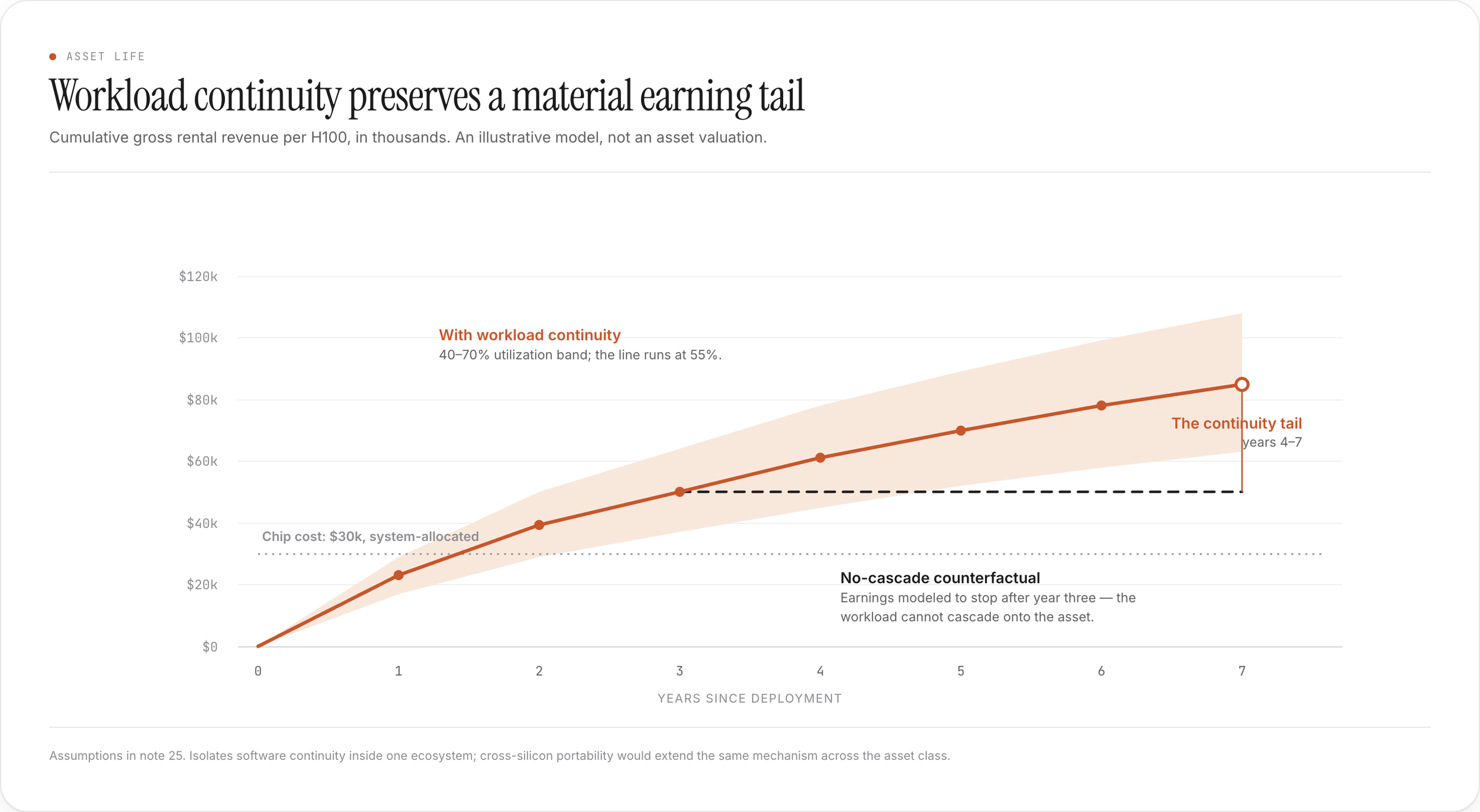
FIG. 06 Cumulative gross rental revenue per H100 with workload continuity vs a no-cascade counterfactual - illustrative model, not an asset valuation. This isolates software continuity inside one ecosystem; cross-silicon portability would extend the same mechanism across the asset class. Assumptions in note 25.
The second major concern in the market that I’ve heard is that there could be a “lump of compute” crisis. The argument is that if the AI buildout at some point decelerates, there will be an increase in debt defaults and repossessions that will arrive at the same time, resulting in gigawatts of capacity hitting the market at once - and the market goes into fire-sale mode. I can appreciate this position, and how folks are arriving at it. If you read the BIS’s June Annual Economic Report 2026, it places the AI buildout explosion in the same mania as the canal buildouts of the 1830s, the railway buildout of the 1840s, the electrification of the 1920’s, and the dot-com bubble - all unquestionably huge breakthroughs that attracted more capital than commercial returns could justify, and each ending in an investment reversal and a recession.[26] I strongly believe that the counter-narrative to this is that we are in a high boom market, an unprecedented demand cycle and clear use cases driving that demand. There will come a point in the next 5-10 years where this enormous cycle will slow - yes, of course - but the point at which this occurs is unknown in my mind as we are still at the earliest point of the S curve on AI innovation.
Not to beat a dead horse, but I’ll come back to aviation again as a comparative because it has already lived through the kind of downturn people are fearing for AI and GPUs. During 2008 to 2010, values for older single-aisle jets fell by as much as 50%, and one in seven sat idle; in 2020, COVID pushed those values down another 15 to 30%, with larger long-haul aircraft falling even further. But the market still kept working - Air Lease kept 99.6% of its fleet leased, the safest aircraft-backed bonds had historically recovered roughly 99.8 cents on the dollar, and by 2023 the value of common single-aisle jets had climbed back above pre-pandemic levels.[27] The Airbus A380 - the giant superjumbo - makes the same point from the other direction, and it is the closest thing aviation has to the silicon argument I’ve been making. Only a small number of airlines were ever equipped to operate it, and its economics were specialized enough that several returned aircraft were dismantled for parts rather than placed with a new carrier.[28] Same industry, same standardized regulatory regime, same downturn - but an entirely different outcome, because the pool of operators who could actually fly it was thin. Standardization did not prevent aviation’s downturns, but it did mean there were still credible buyers when prices fell, and that is the lesson I think carries directly over to compute - portability does not prevent under or oversupply, it determines how many buyers are left willing to own the asset when it arrives.
I continue to believe the question we should be asking is - why does a six-year-old A100 still earn money while a same-vintage custom accelerator cannot do so outside of the owner operating it? The answer I always keep coming back to - it’s the software. CUDA preserves software across GPU generations, and most workloads still run economically on older generation NVIDIA GPUs. That property - portability across generations is why NVIDIA GPUs have the deepest secondary market in AI compute and hold 45% of their value in year three, while other accelerators can be financed only with heavy customer or vendor support and its why creating a liquid market for them is so hard. CUDA is not a counterexample to the portability thesis - it is the strongest existence proof we have. The mechanism has already been proven at enormous scale - NVIDIA is now one of the most valuable companies on Earth. The question is whether it can extend across silicon and create a market where none exists today.
Portability reprices value, it doesn't destroy it
So does a portability layer help or hurt the debt being raised against GPU fleets right now? I think the truth is in the middle.
From everything I’ve researched and read while writing this essay - portability will negatively impact debt underwritten on hardware purchased at prices that only make sense if workloads have nowhere else to go, and were financed on the assumption that lock-in protects their residual value. NVIDIA’s own annual release cadence is already testing that assumption; portability would accelerate the repricing.
Put simply, I believe the lender’s recovery comes down to essentially four questions:
what will someone pay for the hardware,
how likely is it that a new operator can use it,
how quickly can it be put back to work, and
what will that transition cost?
Portability may lower the first number by essentially removing the scarcity premium, but it improves the other three. A lender will usually prefer a lower value it can see and trust over a higher one that depends on one buyer, one vendor and one software stack. My claim is not that portability makes every GPU worth more - instead, it makes the recovery value more dependable - and dependable is what lenders can finance.
In this regard, portability improves the rest of the equation because lenders know how to finance assets that many different buyers can use. NVIDIA GPUs already have a healthy secondary market, but that market is still tied to one software ecosystem which protects the price of those GPUs. A GPU, TPU or AMD accelerator that can run the same workloads through a common software layer belongs to a much larger market, and that’s nothing but good for AI and the world. More operators can take it, older hardware can keep earning as it moves from frontier work to mainstream inference and batch jobs, and workloads can be routed onto machines that would otherwise sit idle. All of that makes the asset easier to recover and easier to finance, and it is what could allow compute to borrow against its own earning power rather than someone else’s balance sheet. Critically, a lender needs the right to keep using the software if the borrower fails, a way for an independent operator to test the seized machines, more than one qualified buyer willing to take them, support contracts and operating records that transfer, and a real market where similar hardware has actually changed hands. Until those things exist, portability is basically still an engineering feature - but once its truly there, it becomes a credit property.
And I suspect the financing spread is not even the biggest number in this story. As I argued in Scale or Surrender, the physical economy of AI ultimately comes down to tokens per dollar per watt. Much of the compute we have already paid for does too little useful work - even a large frontier training run converts only 35 to 47% of a chip’s theoretical peak into useful math.[29] There are many articles where the numbers can be far worse: Alibaba reported median GPU utilization of 4.2%,[30], while The Information reported xAI at roughly 11% MFU on parts of Colossus.[31] These are clearly worst-case examples - in direct customer conversations, I more often hear inference utilization around 50 to 60%, reflecting the sinusoidal nature of day-night traffic patterns. But generally, across the spectrum, they point to a problem - we definitely have machines spending too much time idle, underused, or poorly matched to the work in front of them. Portability cannot remove every memory, network or data constraint, but it can move more workloads onto adequate capacity that would otherwise sit unused.
Under NVIDIA’s own projected benchmark, the same DeepSeek-R1 workload costs about $0.12 per million tokens on GB300 NVL72 and $4.20 on H200.[32] The point I’m making is not that portability magically makes every chip cheaper and busier - its mostly that it gives an operator two separate levers: run each workload on the cheapest system that can meet its requirements, and move other work onto compatible capacity that would otherwise sit idle. Across a mixed fleet, more machines can earn while the blended cost of a token falls. Those gains reinforce one another, because steadier utilization creates steadier cash flows, and steadier cash flows are easier and cheaper to finance. The market is already building the financial machinery around this asset class - GPU futures are being launched, GPU-backed securitizations have started, and rating agencies are writing rules for data-center debt, including how residual values and remarketing should work.[33] All of this leads up to the question - if a lender seizes the hardware, is there anyone else who can actually put it back to work?
Basically, what a bunch of research suggests is that the supply is fundamentally arriving before the software. Google now sells TPUs beyond its own cloud, yet Nebius, Lambda and CoreWeave reportedly remain overwhelmingly oriented around NVIDIA because that is where customer workloads already run and where the software is mature on all the most important models.[34] You can go and examine how many of the latest open weight models run on TPUs or Trainium today by examining their software ecosystems (hint: its not many). I have previously argued that architectural diversity preserves option value, but the same is true of the hardware beneath, as a single compute market is not only less competitive, but less resilient.
My confidence that a multi-silicon future is real is high - on the supply side, I would argue that it has already arrived. The harder question is when debt markets begin to price that reality - long-term contracts and hyperscaler guarantees are real protections today, but they also delay the moment when the hardware has to stand on its own. The BIS already points to debt and equity markets pricing radically different futures[35], while CoreWeave’s earlier facility had to loosen its covenants when customer delivery slipped.[36] The only way that repricing begins is when cash flows force one side to move.
There are also clear ways this thesis could be wrong - for example, if a GPU-backed facility reaches investment grade on the strength of the hardware’s own remarketability, without a hyperscaler backer, then the market will have solved the collateral problem another way. If older GPUs stop finding work at prices that still make economic sense, the case that they retain meaningful value weakens a lot. Until then, my view is pretty simple - lock-in does not protect collateral values - rather, it concentrates risk in one hardware vendor’s roadmap. Portability is what lets compute stand on its own credit, rather than borrowing from a hyperscaler balance sheet or a customer’s contract.
The closing argument
I wanted to finish this already very long essay with two major objections I’ve heard from my friends, and then tackle them one by one after a few weeks of analysis on the debt markets and compute more broadly.
The first critical one - portability has been tried for thirty years and has never worked - OpenCL, SYCL, oneAPI, a decade of ROCm - and CUDA itself took nearly two decades and a massive amount of growth to get the flywheel moving - so a repricing thesis that rests on portability appears to have little historical evidence behind it. “There have been too many failed attempts,” is what I hear. I disagree strongly enough to have spent the last four and a half years building Modular, but I acknowledge that prior efforts have definitely failed. The optimist in me knows that MLIR was built to give the industry a common compiler substrate across fragmented hardware, and it has succeeded at that layer. But a common IR is not an end-to-end AI platform - there is limited value in “abstraction without performance accountability” as this does not make workloads portable and does not yield the TCO benefits. Inference is a kernel-to-cloud systems problem - models, graphs, compilers, kernels, runtimes, serving, memory, networking and operations all have to work together.
The earlier efforts did not all fall short for the same reason - some were governed by committees, some reflected a single vendor’s incentives, some stopped at the compiler, some covered too little of the framework stack, some could not deliver consistent performance, and most arrived before enough alternative capacity existed to justify migration and died on the hill. Chris wrote about these extensively in the Democratizing AI Compute series. But the TLDR is - the common missing combination was an independent incentive, end-to-end compatibility, performance accountability and enough non-NVIDIA supply to respond to the market need. Timing matters a lot in startups and software, and there is no more urgent time than now.
I argue this urgency is why conditions are changing - committed gigawatts of alternative silicon (e.g. AMD, Cerebras, SambaNova, Etched etc) have arrived with paying customers who need workloads to reach them, and inference itself is splitting into different computational stages - prefill, decode, routing, cache and orchestration - these do not all want the same hardware. Liang Wenfeng, the founder of DeepSeek, makes the same point from the other side - in a transcript circulating from a private investor call, he described TileLang as the software layer he believes can move DeepSeek off NVIDIA’s ecosystem and onto domestic chips - leaving capacity, not programmability, as the remaining constraint - and, on his telling, V3 was trained on NVIDIA cards while operating largely outside NVIDIA’s software ecosystem.[37] NVIDIA’s reported $20 billion Groq licensing agreement suggests that it is hedging the same architectural transition.[38]
Further, the commercial bar is not parity with the best hand-tuned run on every kernel - it is higher delivered throughput per dollar across the fleet, after compilation overhead, switching costs, workload suitability and available capacity are included. A slightly less efficient execution path on silicon the workload can actually reach, can beat a perfect kernel on capacity that remains idle and renders a poorer TCO. Equally, the fastest independently verified serving of a trillion-parameter open-weight model right now is not CUDA: Cerebras runs it at 981 tokens per second, 6.7x the best GPU cloud, on the same weights.[39] And yes, no lender prices portability today - that absence is the entire point of this essay.
The second objection I hear is seemingly more existential: “Won’t AI simply rewrite the software for every new chip and make a portability platform unnecessary?”
I think that gets the direction backwards. AI will write more kernels, compiler passes and systems code, but generating code is not the same as operating a production stack. It does not make NVIDIA, AMD, CPUs and custom accelerators share the same memory model, network, compiler or runtime, and it does not make the result automatically correct, fast, reproducible or supportable. As I argued in Probabilistic Engineering and the 24-7 Employee, AI can be probabilistic in how it creates; but the infrastructure beneath it still has to be predictable enough to trust and verify. In fact, the more software agents generate, the less plausible it becomes to hand-port and validate every workload for every machine. I argue that what the world needs is a stable target beneath them - a unified compute platform that can take software written by a person or an agent and reliably run it on the best available hardware. I agree that AI will change who writes the code, but it makes the underlying platform more important, not less, and that has always been Modular’s vision, and it feels even truer now than when we started.
Equally, I believe the credit test is simpler still - a lender cannot underwrite the hope that an agent will rebuild the software stack after a default on the asset. The industry needs a tested platform that another operator can take over and run. If it’s not already obvious, I believe that platform must be open, vendor-neutral, independently testable and durable beyond the company that built it. Otherwise it is not infrastructure - it is simply another dependency.
Software is what makes compute fungible
Ultimately, the irony of learning about debt markets and financing is that making all silicon programmable turns out to be the same problem as making all silicon financeable. We learnt that the shipping container didn’t make shipping valuable - because shipping was always valuable. However, the container did make shipping bankable, and that unlocked the capital that built the modern trading world. I strongly believe that compute is on the same path, and while we are still so early, the destination seems quite obvious. The world’s appetite for tokens is insatiable, the capital required to serve it is staggering, and the financing structures underneath it all are still borrowing credibility from customer contracts because the asset itself cannot yet stand alone.
That is the interface we are building at Modular - one that lets workloads move across capable chips, keeps hardware earning after it changes hands, and allows compute to stand on its own credit. Capital always follows what it can trust. And if that problem excites you, we are hiring aggressively across research, programming languages, compilers, kernels, performance engineering and cloud infrastructure. Come help us build it.
Note: There is another part to this story. These financing terms ultimately flow into the price of every token served, and the dynamic between hardware costs and collapsing token prices is reshaping the world’s inference market. The next essay will be on this dynamic and the interplay accordingly.
Footnotes
Notes below give source attributions. Figures indicative and created by Claude Design (which is awesome!); floating tranches are shown at approximate all-in rates.
1. M&G Investments, “Tech issues: The AI debt deluge hitting bond markets,” Q1 2026, drawing on JPMorgan JULI index analysis (Eric Rosenbaum and Nathaniel Spear, October 2025) - https://www.mandg.com/investments/institutional/en-us-onshore/insights/2026/q1/strat-fi-na-ai-hitting-bond-markets
2. Bank of America Global Research figures via Quartz, “Big Tech’s record borrowing year reshaped the bond market,” May 2026: hyperscaler issuance of $121 billion in 2025 against a 2020-2024 average of roughly $28 billion per year - https://qz.com/tech-hyperscaler-bond-issuance-investment-grade-index-050526. Combined 2026 capital-expenditure guidance of roughly $725 billion for the four largest hyperscalers per company earnings guidance; Alphabet’s raise to $195-205 billion per its July 22, 2026 update, with the initial 2026 range per CNBC - https://www.cnbc.com/2026/02/04/alphabet-resets-the-bar-for-ai-infrastructure-spending.html
3. Chong Sin, head of CMBS research at JPMorgan, projections reported in Bloomberg, “The $3 Trillion AI Data Center Build-Out Becomes All-Consuming for Debt Markets,” February 3, 2026 - https://www.insurancejournal.com/news/international/2026/02/03/856623.htm
4. “The Quarter-Trillion-Dollar Onslaught of AI Bonds Is Testing Investors’ Limits,” The Wall Street Journal, July 2026 - https://www.wsj.com/finance/investing/the-quarter-trillion-dollar-onslaught-of-ai-bonds-is-testing-investors-limits-e4cd2bda
5. I Aldasoro, S Doerr and D Rees, “Financing the AI boom: from cash flows to debt,” BIS Bulletin No 120, Bank for International Settlements, 7 January 2026 - https://www.bis.org/publ/bisbull120.pdf
6. CoreWeave Q1 2026 earnings release (SEC-filed), including total debt of $24.86 billion and interest expense of $536 million on revenue of $2,078 million - https://www.sec.gov/Archives/edgar/data/0001769628/000176962826000220/coreweave1q26earningspress.htm. The August 2023 facility ($2.3 billion, led by Magnetar with Blackstone participation) was described at announcement as the first financing collateralized by NVIDIA H100s, per the company’s release and contemporaneous Reuters coverage.
7. SemiAnalysis H100 1-Year Rental Price Index - https://newsletter.semianalysis.com/p/the-great-gpu-shortage-rental-capacity ; Silicon Data H100 market-value tracking - https://www.silicondata.com/use-cases/h100-gpu-market-value-trends. NVIDIA’s shift to an annual data-center GPU cadence per Jensen Huang’s public roadmap statements (Computex 2024 keynote and subsequent disclosures).
8. hashrateindex used-GPU market tracking (year-three H100 systems at ~45% of new); Silicon Data used-H100 index (~61% at year two, ~69% at year three).
9. Amazon.com Inc Form 10-K (FY2024), useful-life change for a subset of servers and network equipment, and $920 million of accelerated depreciation; Meta Platforms Inc Q4 2024 earnings release and Form 10-K, extension of certain server lives to 5.5 years reducing 2025 depreciation by ~$2.9 billion.
10. Michael Burry, X post, November 10, 2025 (understated depreciation of ~$176 billion 2026-2028; Oracle 2028 earnings overstated 26.9%, Meta 20.8%) - https://x.com/michaeljburry/status/1987918650104283372 ; coverage and NVIDIA’s analyst memo per CNBC, November 11, 2025 - https://www.cnbc.com/2025/11/11/big-short-investor-michael-burry-accuses-ai-hyperscalers-of-artificially-boosting-earnings.html
11. Moody’s Ratings, rating action assigning A3 to CoreWeave Compute Financing DDTL 4.0, March 2026 (six-year Meta take-or-pay MSA, operational IP license, full amortization inside the contract term) - https://ratings.moodys.com/ratings-news/462400 ; CoreWeave press release, “CoreWeave Closes $3.1 Billion Loan Facility” (DDTL 5.0), May 2026 - https://investors.coreweave.com/news/news-details/2026/CoreWeave-Closes-3-1-Billion-Loan-Facility-Expanding-Access-to-Public-Markets-for-GPU-Backed-Financing/default.aspx
12. CoreWeave Inc Forms 8-K, April 14 and April 21, 2026: $1.75 billion and $1.0 billion senior unsecured notes due 2031 at 9.750%.
13. CoreWeave Inc Form 8-K, September 9, 2025 (order form under the April 2023 NVIDIA master services agreement; initial value $6.3 billion; obligation through April 13, 2032) - https://www.sec.gov/Archives/edgar/data/1769628/000176962825000047/crwv-20250909.htm ; NVIDIA $2 billion investments per CoreWeave Q1 2026 release and Nebius Group Form 20-F (pre-funded warrants, March 2026).
14. Bloomberg, “Apollo, Blackstone Seek Investors for $36 Billion Anthropic Chip Financing Deal,” May 28, 2026 - https://www.bloomberg.com/news/articles/2026-05-28/apollo-shops-36-billion-debt-deal-to-buy-google-chips-for-anthropic ; Bloomberg, “Broadcom Backing Lowers Debt Costs on $36 Billion Anthropic Deal,” June 2, 2026 - https://www.bloomberg.com/news/articles/2026-06-02/broadcom-backing-lowers-debt-costs-on-36-billion-anthropic-deal ; Broadcom Inc Form 10-Q (Q2 FY2026), guarantee with maximum exposure of $29 billion.
15. BIS Annual Economic Report 2026, Chapter I, p 25 (circular financing; “the same asset being pledged multiple times”) - https://www.bis.org/publ/arpdf/ar2026e.pdf
16. The Wall Street Journal, “Nvidia in Talks With OpenAI to Guarantee $250 Billion Financing for Data Center,” July 27, 2026; Reuters, July 27, 2026. The reported $250 billion backstop would support financing vehicles for OpenAI’s lease and the data-center build-out, excluding the NVIDIA chips inside it; separate discussions could provide as much as $350 billion of support for chip purchases. Terms were not final and the transaction could still fall apart. NVIDIA’s FY2026 Form 10-K had previously disclosed that it had been asked to provide financing support for customer data-center build-outs and warned that guarantees and related commercial arrangements could increase its exposure to counterparty distress, financing failures, and project delays. https://www.wsj.com/tech/ai/nvidia-in-talks-with-openai-to-guarantee-250-billion-financing-for-data-center-3dd6eae3 Reuters coverage of the WSJ report - https://www.investing.com/news/stock-market-news/nvidia-in-talks-with-openai-to-guarantee-250-billion-financing-for-data-center-wsj-reports-4812926 ; CNBC subsequently confirmed the talks - https://www.cnbc.com/2026/07/27/nvidia-and-openai-in-talks-for-up-to-250-billion-dollar-ai-backstop.html
17. See note 6 for CoreWeave interest expense; co-signer structures per notes 13-14. Aircraft-financing comparison per notes 18-20.
18. Narrowbody value retention per ISTAT Learning Lab, “Appraiser Briefing,” October 18, 2022, p. 11 (“Expected 25-Year Value Curve - Narrowbody”), which presents the expected curve with best- and worst-case ranges and notes dependence on production cycle, replacement aircraft and market strength; young-narrowbody retention commonly in the 80-90% band under normal market assumptions. Repossessed aircraft typically return to revenue service within months given the standardized global operator pool.
19. Moody’s ratings of United Airlines 2018-1 EETC (Class AA at Aa3, Class A at A2, against a Ba2 corporate family rating); United Airlines 2023-1 EETC senior tranche 5.80% coupon per SEC-filed fund holdings; collateral-benefit range per DWU Consulting EETC analyses. The 100-250bp range is my approximate synthesis rather than a quoted market spread: contemporaneous secured EETC seniors (United’s 2023-1 at 5.80%) priced well inside the same issuers’ deep-junk unsecured curves, and ISTAT and rating-agency material attributes six to eight notches of uplift to the collateral package; treat it as a conservative reading of that gap. The full-stack arithmetic ceiling - applying 100-250bp across all $1.2 trillion of AI-tied issuance - would run $12 billion to $30 billion a year; I treat that as a deliberately unrealistic upper bound, since much of that stack is unsecured hyperscaler and corporate paper not priced against GPU collateral. EETC senior-tranche amortization of roughly 12.7 years per rating-agency EETC structural analyses.
20. United 2018-1 EETC tranche ratings (Aa3 senior AA tranche, A2 A tranche) and structural features - Section 1110 protections, cross-default and cross-collateralization, liquidity facilities, loan-to-value - per Moody’s rating announcements and pre-sale materials; United 2023-1 senior coupon of 5.80% per the offering documents. Broader private-credit maturity and secured-share context per BIS Bulletin No. 120 (note 5).
21. DDTL 4.0 loan-to-cost per facility structure disclosures and Moody’s rating action (note 11); Hut 8 River Bend project financing at up to 85% loan-to-cost (JPMorgan and Goldman Sachs), 15-year $7.0 billion FluidStack lease, Google backstop, per Hut 8 press release, December 17, 2025 - https://canada.hut8.com/resources/press-releases/hut-8-signs-15-year-245-mw-ai-data-center-lease-at-river-bend-campus-with-total-contract-value-of-usd7-0-billion
22. NVIDIA Forms 10-K/8-K: data center revenue of $47.5 billion (FY2024), $115.2 billion (FY2025) and $193.7 billion (FY2026, sum of disclosed quarters); Morgan Stanley forecast of ~$570 billion of AI-related debt issuance in 2026 per Reuters via Yahoo Finance, June 10, 2026 - https://finance.yahoo.com/markets/stocks/articles/morgan-stanley-forecasts-ai-debt-135325015.html
23. Azure GPU retirement timelines and used-GPU market data per hashrateindex; A100 rentals and cross-generation pricing per AIMultiple GPU rental index (63 providers) - https://aimultiple.com/gpu-index ; CoreWeave rebooking commentary per CEO remarks at GTC 2026.
24. July 2026 rental cross-section assembled from SemiAnalysis, AIMultiple, Silicon Data and provider list prices. A cross-section across generations and providers - architecture, memory, contract type and market timing all differ - so it does not estimate the depreciation path of any single GPU generation. Indicative, not an appraisal.
25. Author’s illustrative model: $30,000 per H100 (system-allocated), 70% utilization, observed blended reserved price path 2023-2026 then -15% per year. Not a forecast.
26. BIS Annual Economic Report 2026, Chapter I “Progress and peril” (Graph 11.C and pp 22-23), Bank for International Settlements, 28 June 2026 - https://www.bis.org/publ/arpdf/ar2026e.pdf
27. GFC-era value declines per FlightGlobal, “Values in pieces,” March 2010 - https://www.flightglobal.com/airframers/2010/03/special-report-values-in-pieces/ ; COVID declines per Cirium Ascend appraiser data via Aviation Today (Dec 2020/Jan 2021); senior EETC recovery of 99.8% (1994-2014) per Structured Finance Association / EY - https://structuredfinance.org/wp-content/uploads/2020/03/SFA-Primer-Alternative-and-Emerging-Asset-Class-Sportlight-Aircraft-ABS.pdf ; Air Lease Corporation lease utilization of 99.6-99.8% through 2020 per Q3 2020 results - https://www.businesswire.com/news/home/20201109006044/en/Air-Lease-Corporation-Announces-Third-Quarter-2020-Results ; 2021-2023 value recovery per Cirium Ascend.
28. A380 secondary-market outcomes and part-out programs per industry reporting (VAS Aero Services teardowns; Doric Nimrod accumulated depreciation disclosures).
29. MFU definition and PaLM 46.2%: Chowdhery et al, “PaLM: Scaling Language Modeling with Pathways,” arXiv:2204.02311 - https://arxiv.org/abs/2204.02311 ; Llama 3.1 405B at 38-43% BF16 MFU: Meta, “The Llama 3 Herd of Models,” arXiv:2407.21783 - https://arxiv.org/abs/2407.21783 ; Megatron-LM up to ~47% on H100: NVIDIA Megatron-LM repository - https://github.com/NVIDIA/Megatron-LM
30. Weights & Biases (Lukas Biewald): nearly a third of tracked runs average below 15% GPU utilization; Weng et al, “MLaaS in the Wild,” USENIX NSDI 2022 (Alibaba PAI trace, median GPU utilization ~4.2%); Hu et al, “Characterization of Large Language Model Development in the Datacenter,” USENIX NSDI 2024, arXiv:2403.07648 - https://arxiv.org/abs/2403.07648
31. The Information, AI Agenda newsletter, May 2, 2026 (announcement: https://x.com/theinformation/status/2050606311440531809 ); internal memo by xAI president Michael Nicolls (“embarrassingly low”) subsequently obtained by Business Insider. Fleet of ~550,000 H100/H200 GPUs across Memphis/Colossus; 50% MFU target.
32. NVIDIA projected inference benchmarks (GB300 NVL72 at $0.12 per million tokens vs H200 at $4.20, DeepSeek-R1 at FP4, labeled projected) - https://www.nvidia.com/en-us/solutions/ai/inference/ ; AMD MI355X on-demand pricing from $2.59 per GPU-hour on Vultr, spread to ~$8.60 across providers, per GPUPerHour - https://gpuperhour.com/rent/mi355x
33. ICE and Ornn cash-settled GPU compute futures announcement, Business Wire, May 19, 2026; Lambda ~$500 million Macquarie-led GPU financing vehicle, Business Wire, April 4, 2024; data center ABS/CMBS issuance of $23.8 billion through mid-November 2025 per CRA/KBRA - https://media.crai.com/wp-content/uploads/2025/12/03163400/Insights-Data-center-ABS-%E2%80%93-Risks-yields-and-ratings-December2025.pdf ; KBRA data center ABS methodology (comment period through January 3, 2026); Fitch exposure draft, July 2025.
34. Google Q1 2026 earnings call (April 29, 2026), TPU hardware sales to select customers, per Data Center Dynamics - https://www.datacenterdynamics.com/en/news/google-to-sell-tpus-to-a-select-group-of-customers-for-their-data-centers/ ; Blackstone-Google TPU joint venture ($5 billion initial equity, 500 MW by 2027), Blackstone press release, May 18, 2026 - https://www.blackstone.com/news/press/blackstone-announces-joint-venture-with-google-to-create-new-tpu-cloud/ . Neocloud responses per Data Center Dynamics, citing The Information (Nebius CRO Marc Boroditsky: roughly 99% of demand is for NVIDIA GPUs; Lambda and CoreWeave similar) - https://www.datacenterdynamics.com/en/news/nebius-lambda-and-coreweave-unlikely-to-buy-google-tpus-any-time-soon/
35. BIS Annual Economic Report 2026, Chapter I, Graph 13.B (CDS spreads of investment-grade AI names vs CDX North America IG BBB) - https://www.bis.org/publ/arpdf/ar2026e.pdf
36. CoreWeave Inc Form 8-K, January 2, 2026 (DDTL 3.0 amendment effective December 31, 2025).
37. Liang Wenfeng remarks per a transcript of DeepSeek’s May 2026 investor meeting, published in lightly edited form by Tencent Tech in late July 2026 and widely translated; DeepSeek has not confirmed the record, and the circulating original self-describes as automated transcription with inferred speaker attribution, so treat it as directional. Original circulating document (Chinese, Feishu) - https://xiangyangqiaomu.feishu.cn/wiki/Ojsuw8gE6ieBZJkYOMtcOcaenwq , surfaced via https://x.com/vista8/status/2080120593698193844 . Translations and context: RecodeChinaAI - https://www.recodechinaai.com/p/liang-wenfeng-on-agi-compute-and ; Geopolitechs - https://www.geopolitechs.org/p/deepseek-founder-liang-wenfeng-in ; Hello China Tech - https://hellochinatech.com/p/deepseek-liang-wenfeng-transcript . The substance is carried by DeepSeek’s own materials: the DeepSeek-V4 report describes TileLang fused kernels replacing the vast majority of fine-grained operators across training and production inference while preserving rapid development - https://arxiv.org/pdf/2606.19348 ; TileLang itself is an open-source tile-level DSL originating at Peking University - https://github.com/tile-ai/tilelang
38. NVIDIA-Groq: Groq’s announcement confirms a non-exclusive license of its LPU inference technology, value undisclosed; the roughly $20 billion figure, and the hiring of founder Jonathan Ross and senior team, per external reporting - TechCrunch - https://techcrunch.com/2026/06/22/ai-chipmaker-groq-confirms-650m-raise-re-staffs-after-nvidias-20b-not-acqui-hire-deal/ ; Bloomberg - https://www.bloomberg.com/news/articles/2026-06-22/groq-raises-650-million-to-help-startup-pivot-after-nvidia-deal
39. Cerebras serving Moonshot’s Kimi K2.6 (one trillion parameters) at 981 output tokens per second, independently verified by Artificial Analysis - 6.7x the next-fastest GPU-based provider and 23x the median - per VentureBeat, May 2026 - https://venturebeat.com/technology/cerebras-says-its-chips-run-a-trillion-parameter-ai-model-nearly-7-times-faster-than-gpu-clouds
